

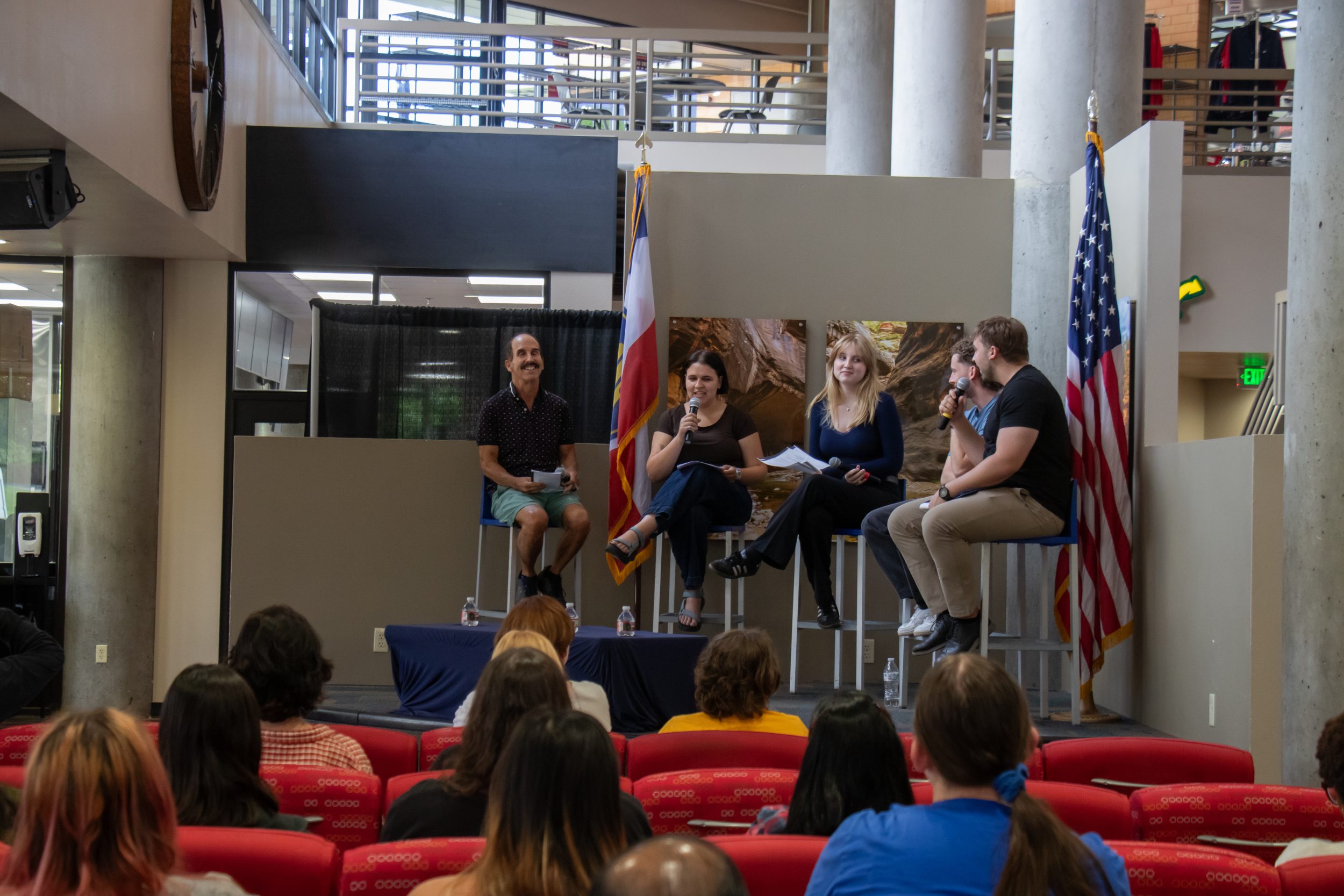
Utah Tech University’s Institute of Politics kicked off its Spring Mixer events with two discussions April 14: one on Shakespeare and the other on Iran.
Both discussions, located in the Gardner Student Center Living Room, went over current politicians and political issues with students and community members.
This event was the first of the two events the IOP is holding for their Spring Mixer, and the second event was held April 16, where the IOP had panelists speak on academic freedom and freedom of the press.
Shakespeare monologue and discussion
In a collaboration with the English department, the IOP had students from a class that studies William Shakespeare read live from 4:30 to 5:30 p.m.
Students read scenes and monologues from “Henry IV,” tying a connection to the political relevance the piece has today. The audience members were able to connect character personalities to the current politicians in the real world. Student performers connected President Donald Trump’s personality to match the character Falstaff because both use comedy, but also can make bad decisions because of that.
Panel forum on Iran
From 6 to 7 p.m. the IOP held a discussion on the current conflict between the United States and Iran. The United States is currently in conflict with Iran to prevent them from developing nuclear weapons and making a regime change. The U.S. wants to stop Iran from being able to support proxies.
The panellists included:
- Arthur Anderson, graduate student from the Defense Language Institute
- Todd Renda, practicing attorney
- Glenn Webb, professor and associate dean for College of the Arts
- Ravneet Kaur, graduate student from the University of Utah
Vince Brown is the director of the IOP and acted as the moderator during the panel.
“Wars happen, we are humans and we find ourselves in different situations in conflict,” Webb said. “We haven’t had anything to provoke a war at this point.”
Topics that were discussed during the panel included the justification, wisdom and diversity of the conflict and whether it’s worth it.
Kaur is a graduate from the University of Utah with a bachelor’s in political science who is now pursuing her master’s in government at Johns Hopkins University.
“It’s not going to be worth it for the American people,” Kaur said. “Sending troops to a country that is just a repeat of Afghanistan is not going to be beneficial.”
Anderson is a student at the University of Utah for political science, and has seven years of experience within the military and working in the intelligence sphere. Anderson has worked in Iraq and Syria, and has worked with issues between Iran and the United States.
“When we look at the logistics in actually doing so, from what I understand, we have a pretty good idea where all this nuclear material actually is,” Anderson said. “We look at how deterrence has existed throughout the world in post-World War II. Nuclear weapons keep people in power.”
Renda has been an attorney for 36 years and explained the War Powers Act, a federal law.
“Under the War Powers Act, the president rarely has to notify Congress of his intent to put troops within a hostile area,” Renda said.