
Utah Tech University’s LGBTQSO Club partnered with local voting organizations to host a free “Know Your Rights” seminar focused on voting, voter registration and protest rights.
The seminar was a collaboration between:
- LGBTQSO
- American Civil Liberties Union of Utah
- American Federation of Teachers
- Together Works of Southern Utah
- League of Women Voters of Washington County
- Equality Utah
LGBTQSO president, Mason Britton, a senior history major from Lake Havasu City, Arizona, said events like this are important.
“It boils down to advocacy and advocating for everyone who might not have a voice, or who feels like they don’t have a voice on campus,” Britton said.
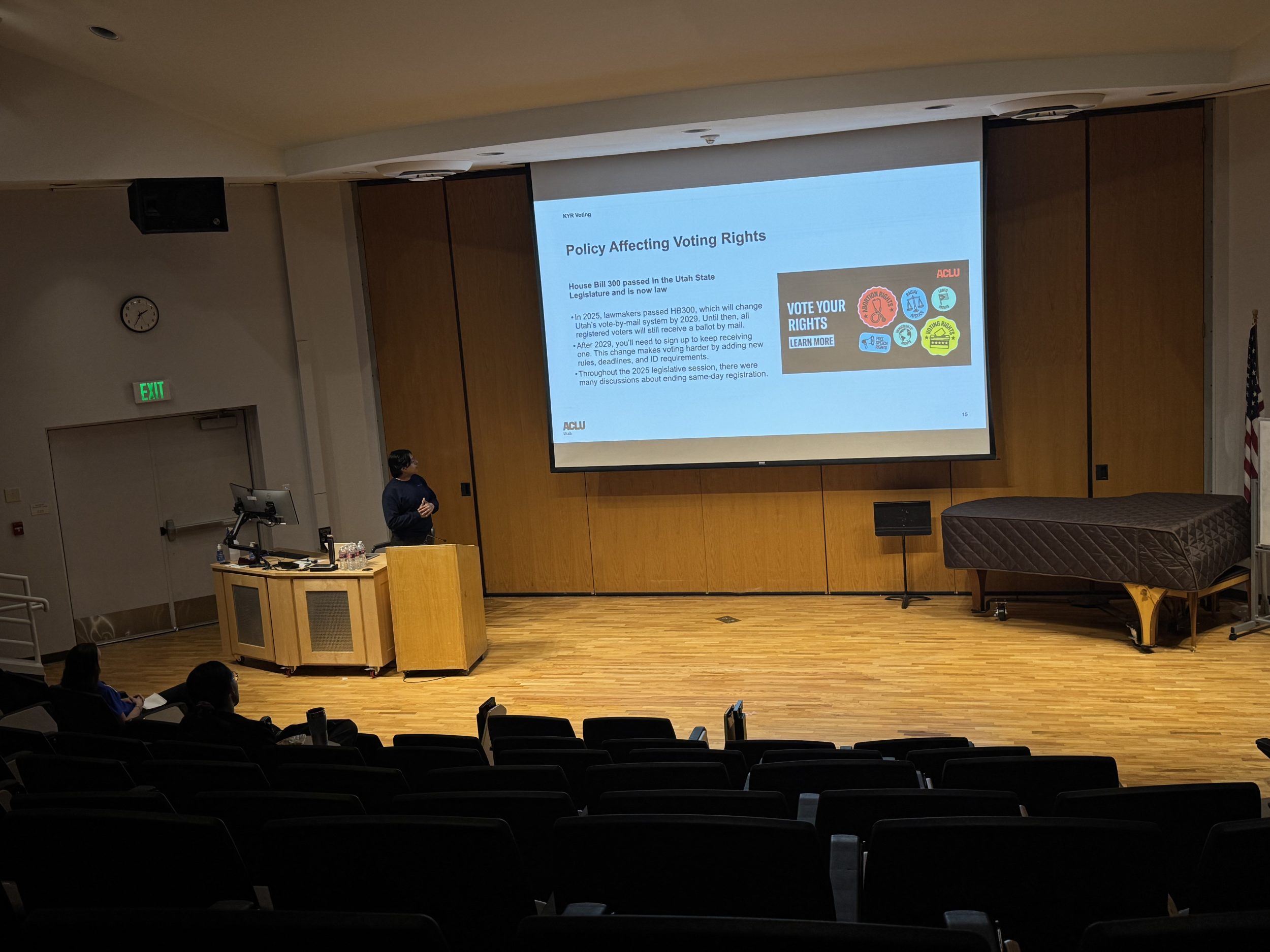
The ACLU of Utah presented a two-part seminar. The first portion, led by advocacy and policy intern Suvam Pokhrel, focused on voting. The second portion, led by community engagement director Allison Griffith, focused on protest rights. The information presented applied specifically to Utah law.
The event provided attendees with information about their rights, as well as resources and tips.
“It’s important to know your rights, just to have that continuum of education,” said Aleia Salud, a junior digital media major from San Clemente, California.
Voting
Pokhrel said out-of-state students can vote in Utah as long as they have lived in Utah for at least 30 days.
“In the 2024 presidential election, young voters ages 18 to 29 were the group that voted the least out of all the groups,” Pokhrel said.
Pokhrel explained how to vote, who is eligible, what documents are required for registration and upcoming changes to voting laws.
For mail-in ballots, voters should mail their ballots 11 days before election day.
“If the ballot would arrive close to the 11 day [mark], it is recommended to vote in person to ensure your vote is counted,” Pokhrel said.
Pokhrel said in-person voting can be simpler because voters only need to provide proof of name and current address, while mail-in ballots require signature verification.
He added that although identification is not currently required for mail-in ballots, that will change in 2029 due to HB 300. HB 300 focuses on mail ballots. Currently, all voters receive ballots in the mail, and this bill changes that voters will need to opt in to receive mail ballots.
Another bill was passed during this last legislative session, HB 209, which requires voters to show proof of citizenship.
“This requirement would likely make it burdensome towards women or other voters who have undergone a name change; they will need to provide even more documentation, such as a marriage certificate,” Pokhrel said.
Protesting
Griffith discussed the First Amendment and how it applies to protests. She advised attendees to prioritize their safety and assess each situation.
The First Amendment allows freedom of speech, press, religion, assembly and petitioning the government. It also protects the right to express disagreement.
“Everyone is guaranteed the rights that are in the U.S. Constitution,” Griffith said.
Griffith said people are lawfully allowed to discuss their constitutional rights, and do not need to be a lawyer to educate and share this information.
Griffith said government officials may enforce time, place and manner restrictions to maintain public safety, manage traffic flow and ensure noise compliance during protests.
“The First Amendment does not protect symbolic acts and civil disobedience that involve illegal conduct,” Griffith said.
Griffith said that to plan a protest, organizers would need a permit, and recommended talking to law enforcement beforehand to inform them of the event and build a relationship with them.
She also discussed documentation during interactions with law enforcement, noting that officers must have a warrant or legal justification to conduct searches.
“The best practice while video recording or photographing, for digital documentation, is to immediately make a copy on a second device and do not edit or alter that copy,” Griffith said.
Griffith advised the audience to stay calm and make sure their hands are visible if law enforcement detains them.
“Don’t argue, resist or obstruct the police and the opposition they are doing, even if you think your rights are being violated,” Griffith said.
After the seminar, tables were set up for attendees to speak with representatives from the ACLU and the League of Women Voters and register to vote.
Q&A
During the Q&A session, one audience member asked about protests on university campuses. Griffith said some universities designate specific free speech areas, though policies vary by institution.
Another attendee asked about training opportunities for peaceful protests. Griffith said activist groups, including Indivisible and its partners, offer training sessions.
Griffith said students can get involved and access additional resources through the ACLU of Utah’s website.