

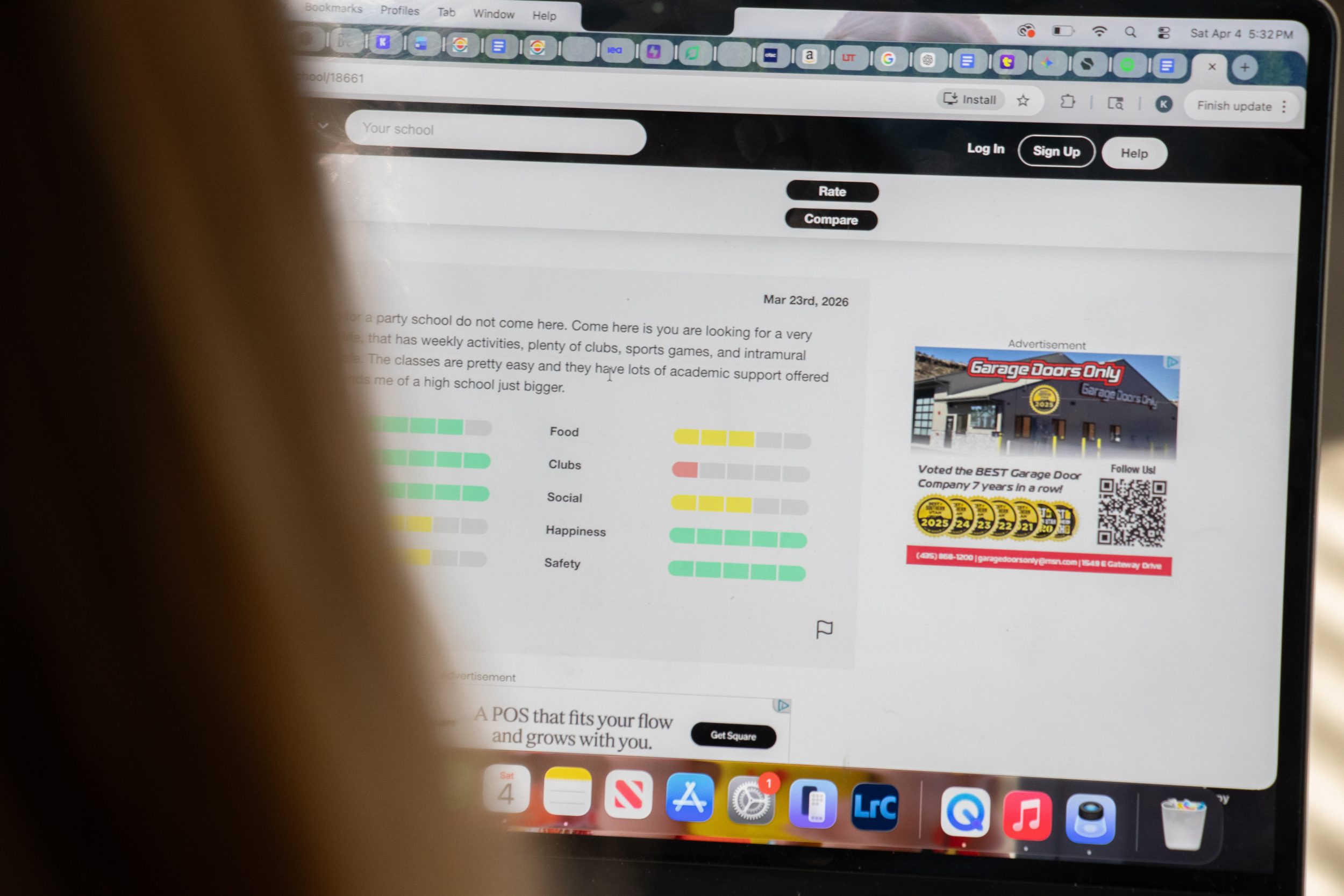
While some students turn to Rate My Professors for guidance on classes, a few Utah Tech University faculty and staff say official course evaluations — not anonymous reviews — are what truly matter.
Rate My Professors is widely used by college students to evaluate instructors, learn how courses are structured, and determine whether attendance is required. However, the site does not verify whether reviewers have actually taken a course, raising concerns about accuracy and fairness.
In contrast, Utah Tech uses course evaluations through Canvas that are only available to students enrolled in a class. These evaluations are reviewed by department chairs, deans and supervisors, and are used to improve instruction.
Rhiannon Bent, assistant professor of communication and department chair, said, “I wish more students would take the course evaluations done on campus more seriously and provide constructive criticism or praise.”
“Someone told me about [Rate My Professors] a couple of years ago. I haven’t visited it since, but I don’t rely on the feedback given,” said Robert Kramer, a part-time psychology professor. “I always read the feedback students give on Canvas.”
Shawn Denevan, director of radio and communication professor, said he changes his courses based on the feedback given in the Utah Tech course surveys.
“I would never use Rate My Professors as a legitimate source of feedback,” Denevan said.
Denevan said it can sometimes be obvious which student wrote a negative comment based on writing styles or complaints.
“I am a human being with feelings, and negative comments do hurt,” Denevan said. “I’m also one that’s open for discussion, communication and change.”
Negative comments can be posted on Rate My Professors for anyone to read. Most comments focus on students’ experience in the class and do not provide constructive advice for students or professors.
On the website, you can see professors from every university. Examples of comments include students saying classes are torturous and they wish they could get a refund. Other comments have been left saying that group study nights are more efficient at teaching than professors. Because the website does not require proof of enrollment, it lacks credibility and fairness.
Kramer questioned the intent behind some anonymous posts.
“Why would a student leave a negative review on a course they didn’t take unless they had a personal agenda against that professor?” Kramer said.
If Rate My Professors had the grading scale, course syllabus, the student’s name and GPA, it would give the website greater credibility, Denevan said.
“By removing the anonymous nature of the website, it’s possible that more accurate reviews would be given, and that those reading those reviews would be able to have information to judge the reviewer on as well,” Denevan said.
Kramer said students should provide detailed feedback in course evaluations through Canvas, as they are tools instructors use to improve.
“Canvas course evaluations are read and valued, and they are one of the best tools to address concerns about a course or instructor,” Bent said.