


The annual Truth in Tuition was held Feb. 24 in the Dunford Auditorium, proposing a 4.54% increase in tuition and 6.45% decrease in student fees for the 2026-2027 school year.
Bryant Flake, executive director of planning and budget, started the meeting with graphs and statistics regarding inflation for tuition.
- Resident tuition will increase from $2,785 to $2,910
- Nonresident tuition will increase from $8,900 to $9,304
Flake said that Utah Tech University was faced with a new challenge of keeping the inflation of tuition to align with the cost of living. He also stated that after Utah Governor Spencer Cox requested a tuition freeze for higher education for the 2023-2024 school year, it presented challenges for day-to-day operations. These challenges from the freeze, along with inflation, are still seen through the upcoming school year.
“We had to pivot and prepare for that significant change, after the government made that request,” Flake said.
The proposed tuition changes were developed through the university’s budget process along with the Student Fee Advisory Board. The proposed fee changes must be approved by the Utah Tech Board of Trustees and reviewed by the Utah Board of Higher Education March 27 before taking effect.
How would tuition money be used?
Utah Tech continues to have the lowest tuition out of the four regional universities. The majority of general revenue comes from state appropriation, meaning the state of Utah funds most of the money. In total, the school has allotted $121,030,800, with 39% from tuition and 61% from state appropriations.
“This is actually a pretty big deal,” Flake said. He also mentioned how in surrounding states, universities will often get 30% to 50% funding from the state.
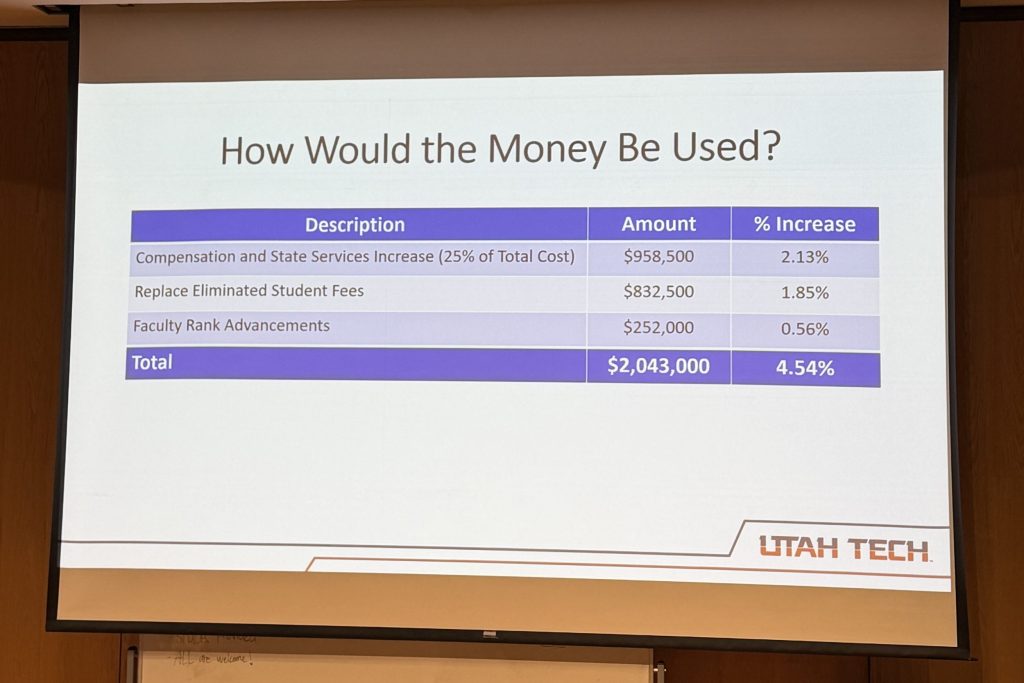
With the increased 6.45% tuition costs, Flake provided this graph:
- Compensation and state services increase: 2.13%
- Replace eliminated student fees: 1.85%
- Faculty rank advancements: 0.56%
Louraina Minor, a junior English education major from Moab, said: “When you actually look at it from like a college’s perspective, it makes a lot more sense. I also think this was a lot more clarifying than I thought it would be.”
Student fee decrease
The Student Fee Advisory Board proposed 6.45% decrease, making the student fee total $427.50.
The board has students who were not affiliated with Utah Tech Student Association, also known as students at large. These students were included on the board to give more insight and perspective on how student fees are managed and dispersed. The board consisted of six UTSA members and four students at large.
Shellsea Ramirez, a senior individualized studies major from St. George and UTSA president, said, “It’s kind of awesome to be able to express your peers’ perspectives.”
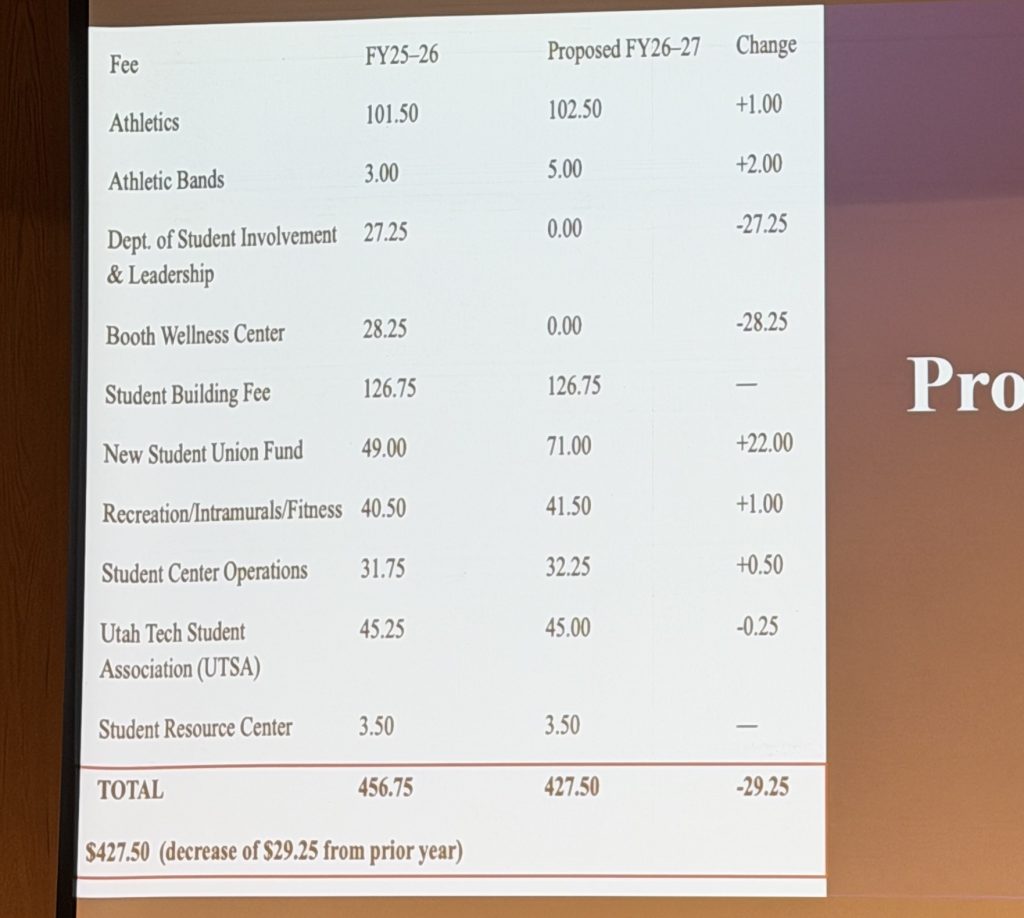
The Student Fee Advisory Board referenced Policy R516 to inform students how fees were being implemented for each category.
The Booth Wellness Center and Department of Student Involvement and Leadership will have eliminated fees. The Student Fee Advisory Board recommended that the university still maintain the free mental health consultations for students into the 2026-2027 school year.
The money eliminated from the Department of Student Involvement and Leadership and the Booth Wellness Center is not being redirected to a single program, but instead into the overall cost of tuition.
The removal of those two fees, combined with increases for the Student Union Building, athletics, athletic bands and a 4.54% tuition increase, were calculated together as part of a broader financial restructuring.
Flake said that eliminating the two fees helped offset the new increases, meaning students will see a smaller rise in tuition cost than they would have if the fees had remained in place.
In order to get approved, the Student Fee Advisory Board will present to the university council, the board of trustees and USHE. This will be taking place within the next few months.