

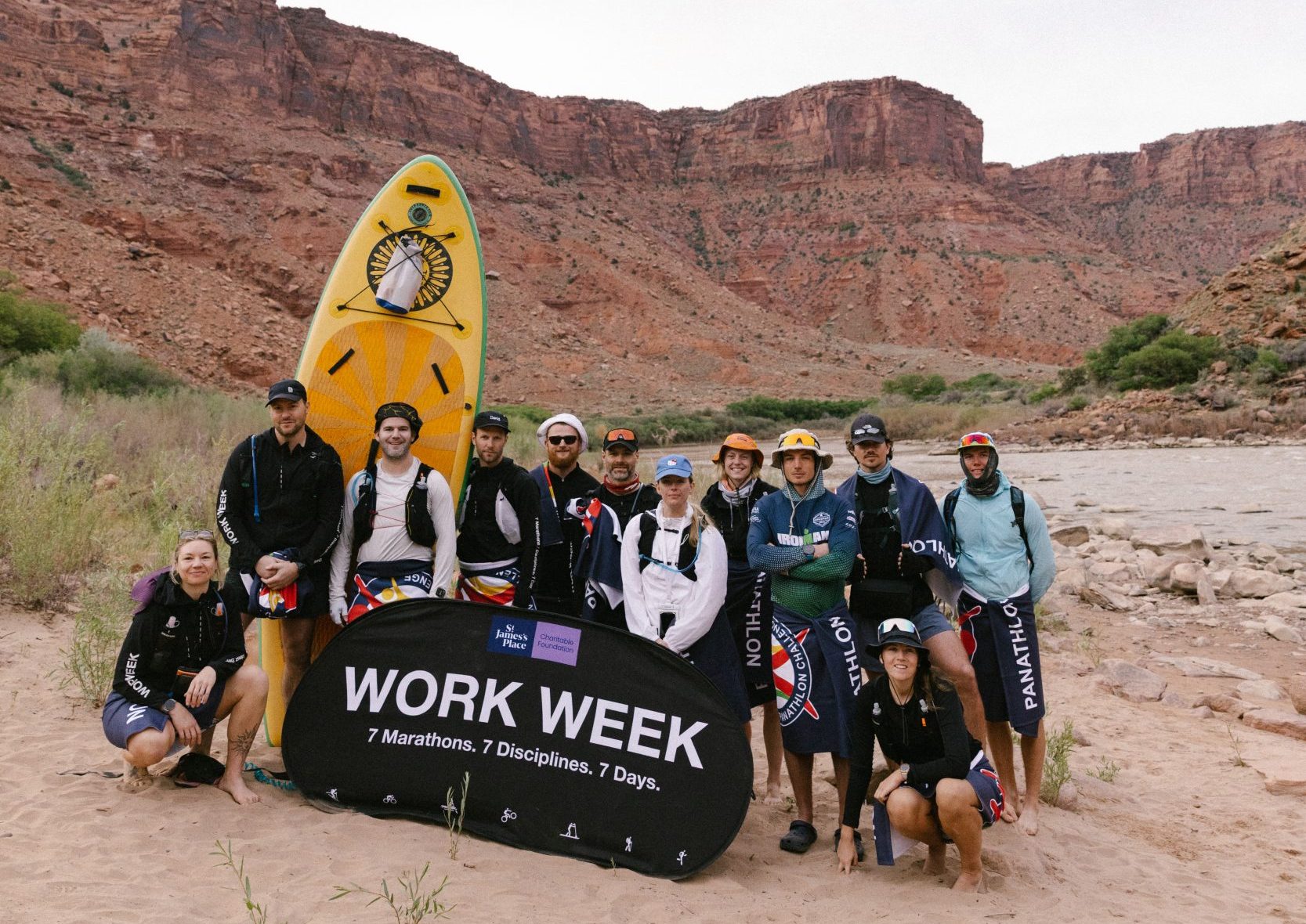
Work Week returned to Utah this April with a simple premise: bring together everyday athletes and push them through seven demanding days of endurance disciplines while raising money for mental health and youth-focused charities.
From April 6–12, 12 participants completed seven disciplines across Utah, traveling from Snowbird to Zion National Park in a week that tested both physical endurance and emotional resilience. The seven-day endurance event included:
- Alpine skiing at Snowbird
- Road cycling through Salt Lake City
- Kayaking in Moab
- Mountain biking in Canyonlands National Park
- Stand-up paddleboarding in Moab
- Hiking in Bryce Canyon National Park
- A final run through Zion National Park
Unlike traditional endurance events, Work Week is not a race. There are no podiums, rankings or winners. Participants move together, support one another and focus on completing each day’s effort as a group.
Each day’s discipline was completed at a marathon distance effort, including cycling stages of roughly 100 miles. The format emphasized sustained endurance over speed, requiring athletes to manage fatigue across all seven days.
Work Week was co-founded by Ricky Bowry, who also participated as one of the 12 athletes this year. Founded in 2025, Work Week was created to blend multi-disciplinary endurance challenges with charitable impact, bringing everyday athletes together for demanding outdoor events designed to test physical and mental limits.
According to organizers, the event is built on the belief that hard work can drive change — both personally and within communities. Participants complete seven days of endurance challenges while fundraising for causes that matter to them, emphasizing resilience, shared effort and collective growth rather than competition.
The event raises money through participant fundraising. Donations are matched by St. James’s Place and benefit Panathlon, a U.K. based charity that provides competitive sporting opportunities for young people with disabilities. Funds are also directed to CALM, which focuses on mental health awareness and suicide prevention.
While participants came from different backgrounds and professions, none were professional athletes. Most held full-time jobs outside of sports, making the physical and emotional toll of the week especially demanding. Many struggled throughout the event, but every participant finished.
For Ben Hallaways, a level two ski instructor from Reading, England, returning for a second year carried personal significance. Hallaways said endurance sports became an outlet for him after his sister died by suicide.
“Work Week is a great way to test mental strength,” Hallaways said. “The causes behind it are very personal, and you feel a responsibility to do your best for those people and charities.”
Hallaways said this year’s endurance event highlighted how much Work Week has grown since its first edition in 2025, from improved logistics to additional participants, while still preserving its core purpose.
“A lot of blood, sweat and tears went into it,” he said. “Everyone had their own motivations, and when you put them together, it created something really special.”
For first-time participant Chloe Hauenstein, a Salt Lake City native now living in New York City and working as a corporate marketing director at Traversal, the experience was as much mental as physical.
“My mind is usually overrun with thoughts, but during something like this, it quiets down completely,” Hauenstein said. “You’re not thinking about anything else, just getting through, one foot, one pedal or one paddle stroke at a time.”
Hauenstein said the group dynamic was one of the defining aspects of the week, especially during the mountain biking stage at Canyonlands National Park, which she described as one of the most difficult days.
“One of the guys refused to let me quit,” she said. “He stayed with me through the hardest sections and wouldn’t leave my side. That kind of support is not something you get in most endurance events.”
Another participant, Luke Grose, a CEO from Ringwood, United Kingdom, said the variety of the challenge and the collective mindset were what drew him to the event.
“The power of having a team of us working together was huge,” Grose said. “We all spiked on different days, and the strength of the collective was greater than any individual.”
Throughout the week, participants leaned heavily on one another, as well as on support crews and community members following along online. Emotional moments were common, particularly at finish lines, where exhaustion often gave way to tears, relief and shared celebration.
Hallaways said that openness — both physical and emotional — is central to what separates Work Week from traditional endurance events.
“When we hit walls, we’re open about what’s going on in our heads,” he said. “It shows how community and teamwork are the best remedies for those private battles.”
By the end of the week, what stood out most was not individual performance, but collective perseverance. Participants who struggled one day often became sources of encouragement the next, reinforcing the event’s emphasis on shared effort rather than competition.
Work Week organizers hope that giving the public a window into that process — the struggle, vulnerability and eventual completion — helps normalize conversations around mental health and encourages others to challenge themselves within supportive environments.
For participants like Hauenstein, the message was straightforward.
“You don’t need to be perfect going in,” she said. “You just need to be willing to try.”