

Academic advisers exist to aid students, and while there can be a disconnect between students and advisers on goals or expectations, both sides are taking steps to create an efficient and positive advising environment.
In response to student complaints about their academic advising experiences, the Utah Tech Student Association sent out a survey that asked students to provide feedback about Utah Tech University’s academic advising quality in fall 2025.
Kolby Spector, the vice president of academics, said the feedback consisted of positive and negative reviews.
“The biggest observation we made is that most negative responses surrounding adviser availability and support were in colleges where the 300:1 student-to-adviser ratio was exceeded,” he said. Spector said that includes health sciences and SET.
Spector, a senior mathematics teacher education major from Fort Ann, New York, also noted that the UTSA Student Senate worked closely with the academic advising department to help create the survey, and he said UTSA is appreciative of their cooperation and hard work.
“The Student Senate organized the data into a resolution. This is a formal document expressing the student voice to the university,” Spector said. “The resolution has been presented to academic administration, and the university is currently working on approving funding to hire more full-time advisers in the areas that exceed the ratio.”
Deborah Decker, UT’s director of first-year advisement, said that the survey highlighted this skewed availability as one of the advising office’s pain points, which she said directly relates to students’ advising experience.
“We kind of had it on our radar, [and we] predicted, ‘What are the next colleges where we really need to advocate for positions?’” said Katie Armstrong, the director of college advisement.
Despite potential issues, both students and advisers highlighted steps each side can take to better the experience.
Advisers
Beverly Clark, an adviser for general education, helps incoming students explore various majors. She said her main goal is to make students feel comfortable when they come in for help, to make school easier for them.
“[The advisers] are here to advise, [students] decide,” Clark said. “I think a lot of times, students think we are going to tell them what to do… I don’t want you to have a horrible experience or a horrible class. I would hope they know that we’re here to help them. And that’s the idea, is to try and give them options, and then they choose.”
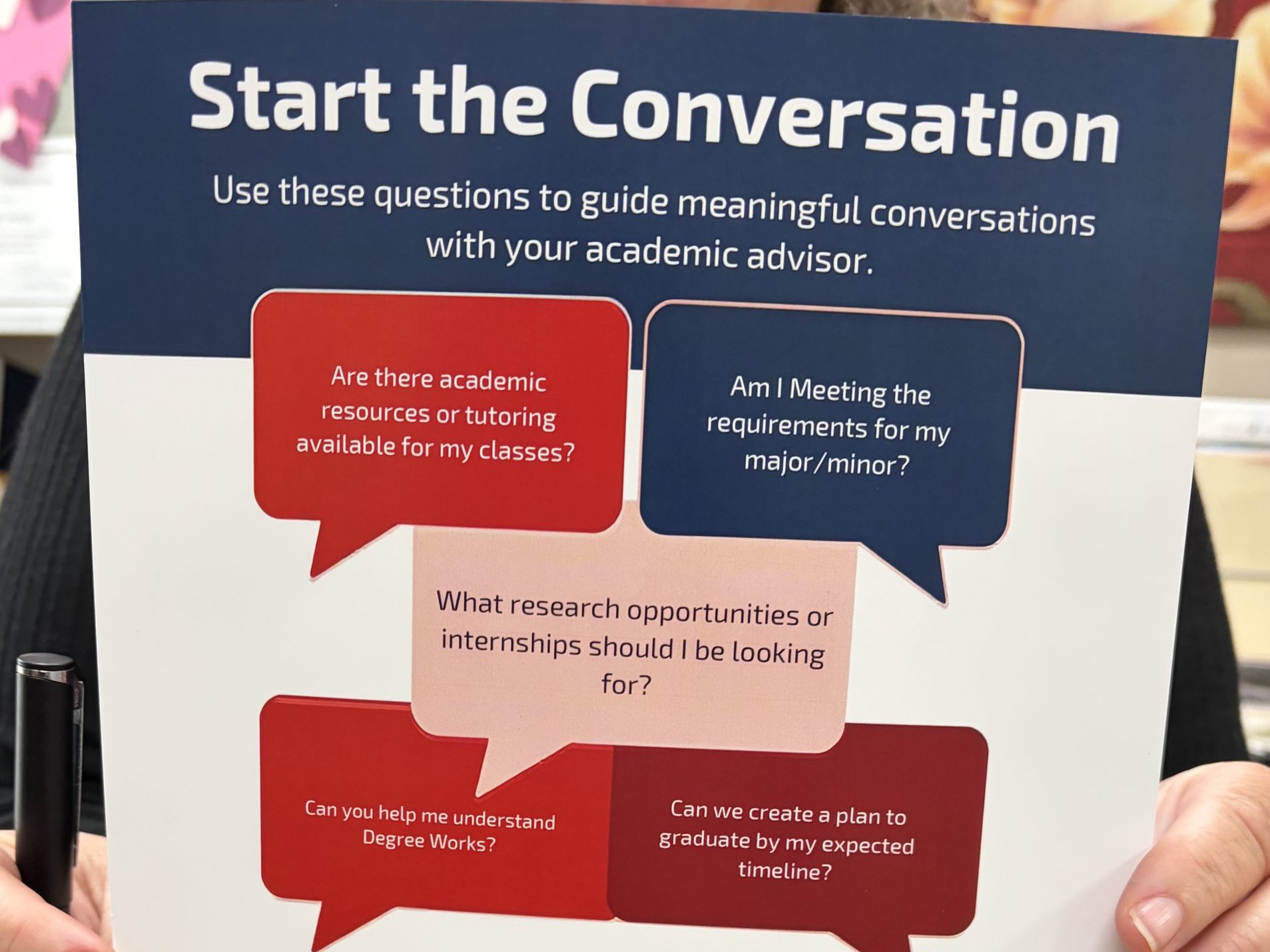
Clark suggested that students write down questions they have for their adviser before the meetings. On her desk, she had a diagram of potential questions students could ask during advising meetings. She also urges students to take notes during these meetings.
“I think sometimes this is where some of those gaps come [from]” she said. “[Students] feel like, ‘You told me this,’ and [the advisers] do keep notes, so we can go back and look and be like ‘Hey, I didn’t. And actually, it shows I sent this email to you on this date.'”
Armstrong noted that advisers use a proactive advising model that exists to teach students about their degree requirements, so by their senior year, they’ll have a strong understanding of how the process works.
“We want you to come prepared,” she said. “So that’s what we mean by take ownership, because we want you to make those decisions.”
Armstrong said the advisers exist to encourage and guide students to other resources, and she said there is a misconception that advisers just exist to help build class schedules.
“We have so many great resources,” Decker said. “Look at Degree Works. Take a look at some of the courses… But also, share your broader goals [with your adviser]. We’re asking students not only ‘What do you think you want to do?’ but ‘What do you know you don’t want to do?’ Because sometimes that’s a really important part of the conversation.”
Students
A few students shared their thoughts on improving academic advising opportunities.
“I think as a student, it’s good to know what your path kind of looks like,” said Collin Mikkelsen, a junior digital media major from Clinton. “Like paying attention to the Degree Works page that we have. I think that’s really helpful, showing exactly what it is that you have to do. That’s pretty much what my adviser just talks to me about anyway.”
Mikkelsen said he did not speak with an adviser in his first semester and registered for classes based on the Degree Works page.
Now, he said his experience with his adviser has been positive. His adviser provided various resources to guide him through the process of changing majors, including Career Services. He thinks advisers being supportive and friendly can help improve the experience for students.
“[The advisers] are super nice people, [but] they always feel a little scattered,” said Ava Reall, a senior individualized studies major from Kent, Washington. “I know they have a lot of students to look over, but it’d be really helpful if when you meet with them, they have an idea of what you need.”
She would like to see more advisers come into the appointments more prepared and have a strong grasp on the information they’re sharing.
“When they don’t seem sure, you get nervous to take their advice because you don’t feel sure,” she said.
Reall also said that while students should always know what they are getting into and understand their major’s requirements, an adviser should be able to tell them what they’ll need.
“I feel like I kind of had to already know what I needed to know coming in, and just double check with [my adviser],” she said. “Because I never felt, even up until now, that my advisers could provide new information. It was more like I was just double-checking my facts.”
Effort from both advisers and students improve the experience
Both students and advisers emphasized the importance of students taking responsibility for their academic journey.
“We want to be that resource for students,” Decker said. “We know it can be challenging when we have larger populations. I want to get the message out there that you can make an appointment anytime, and you can make one up to 30 days in advance… But if we plan ahead, or if we have a little bit more flexibility, usually it can work out.”
“Advisers care about students,” Armstrong said. “We care about you. We want to support you. We try to get that message out all the time.”