UTAH TECH UNIVERSITY'S STUDENT NEWS SOURCE | May 04, 2026

Navigating communication and media consumption in the digital era

By Ashley Orduna

This story is jointly published as part of the Utah College Media Collaborative, a cross-campus project bringing together emerging journalists from Salt Lake Community College, Southern Utah University, the University of Utah, Utah Tech University and Weber State University. The collaborative is an Amplify Utah project with support from PBS Utah.

Those who grew up during the beginning of the digital age can recall the magic of MySpace— a new form of connecting with friends and showcasing one’s personality. From being able to put a soundtrack on your blog to posting photos, commenting and sending messages, media has become a normal part of life.

Whether by choice or by social standards, navigating online life has become a must in newer generations. 

Trends between millennials; Gen Z 

Compared to millennials, Gen Z uses social media more overall, with data showing that 90% of Gen Z use social media platforms. 

Gen Z is definitely influenced by social media, but honestly, every generation is at this point,” said Li Chen, associate professor of social media and data analytics at Weber State University. 

However, millennials are more likely to say they are addicted to social media compared to Gen Z. Data from Civic Science reported that young adults aged 18 -24 use social media less compared to the same age group five years ago. 

The link between social displacement and social media

Although, from a broad perspective, lack of in-person engagement can be seen as the result of social media, from an individual perspective, social media and communication actually showed a positive relationship.

Social media has been used as a tool to continue communication while adapting to busy lifestyles. And time spent on social media showed no actual disruption of future in-person meet-ups.

Out of the average three hours spent on social media, a significant portion of that time was spent communicating with others. 

However, increased social media use has prompted research into the phenomenon of social displacement, which looks at the idea of how face-to-face time is being replaced with social media or online connections. 

The idea of social displacement has had mixed results, linking social media to a concept that predates social media itself. However, one link was clear: social media’s link to the loneliness epidemic.  

Connection vs. communication

“I think we’ve seen isolation [more], so less about communication and more about connection,” said Marni Brunstetter, mental health therapist and social worker at Salt Lake Community College. 

Brunstetter offered advice on building connections in the digital age. “We have all the ability to make the social connections we’ve been making since the dawn of civilization, and we don’t need another app—we don’t need the phones—to fix it for us,” she said. “We can be the ones that make the choices that get us in more connection with others, that help us feel that we know our neighbors. Reach out to them to build that sense of humanity.” 

According to Associate Professor of Communication Sarah Billington, who teaches Interpersonal Communication, connecting in person brings about the richest form of connection. 

“When I hear the word ‘connect,’ I think of something meaningful,” she said. 

Billington explained communicating can be used for connection but connection itself cannot be used to communicate. 

“The purpose of communicating is to get the message out, right? But I think often, people are communicating to connect,” she said.

Communicating to connect can best be exemplified by building communities with meaningful friendships that can lead to more personal connections. 

In contrast, communicating alone can look like posting photos, statuses or commentary with no intention to allow others to engage in a meaningful way.

“That was why social media was really invented,” Billington said. “You could get online, you could share your story, you could even maybe meet people. The intention is to connect, often.”

“However, I think sometimes people get on there [social platforms] often as well to just communicate something,” she said. 

Connecting in a digital world

“I do think in general people are less connected on a personal level,” said Heather Cunningham, SLCC Fashion Institute student. “I feel like people struggle [to] maintain relationships…like understanding each other on a fundamental personal connection.” 

Cunningham said she felt as though everywhere she went, peers complained about how hard it was to make those personal connections.

“While I think part of that is the effect of growing up and becoming an adult, I think a big part of that is that it’s just a different set of skills that you have to put in to create those personal connections versus creating online connections.”

Haley Von Niederhausern, another SLCC Fashion Institute student, uses social media to find “pseudo communities” that offer opportunities to find genuine connections. But, she added, “They’re not true communities, because there’s no true personal connection.” 

While Von Niederhausern doesn’t discredit the online communities, she explained that everyone should also have real-world connections. Even though it is something she struggles with, she said she still makes the effort to build those relationships.

Algorithms and the echo chamber effect 

Echo chambers, or silos, are parts of algorithms that only feed users material that is similar to each other, often only fostering one narrative. 

“The real issue is how echo chambers trap people in one perspective,” said Li Chen. “Social media makes it super easy to only see content that reinforces your beliefs, which can distort how you see the world. For Gen Z, who often rely on these platforms for news, it can be tricky to sort out what’s real and what’s just hype,” 

“If all you consume is the hyper-reactionary content … that, in my opinion, is what trends more towards brain rot. It’s also actively participating in that—where you’re commenting on it, you’re taking those feelings into your real life—you’re again, feeding, almost submitting to those echo chambers,” said Von Neideierhausern.

Jarrod Ventura, positive media psychologist and Ph.D. candidate at Chapman University, combats online echo chambers by challenging his students to “break their feed.”

Breaking one’s feed is purposefully engaging with content outside of personal beliefs, such as liking videos that show an opposing view of a political issue. This creates a “confused” algorithm that cannot gather enough data to show similar videos, breaking a user out of echo chambers and exposing them to broad perspectives online.

Mindfulness in media consumption

Along with his challenge to “break the feed,” Ventura teaches his students mindfulness by incorporating meditations throughout class and teaching how to use media for good. 

“I basically try to find all the positives and goods right? So, how can positive media elicit happiness [and] love … when someone is more likely to experience positive emotions that becomes their default after a certain point,” said Ventura.

Social media can play a part in depression and anxiety, but it isn’t so much social media itself but the content consumed. Positive media psychology focuses on the potential of technology while encouraging people to become more aware of their own consumer habits. 

There are platforms, such as Joybox and Marco Polo, that create a more uplifting environment for users. According to Ventura, these apps are designed for users to “spiral upwards” with positive media use habits by viewing content that makes them feel good emotionally.

However, these platforms have not gained the same traction as Instagram, Facebook and other mainstream apps.

“There definitely needs to be more introductions of positive media into our mainstream [platforms].” said Ventura.

However, in terms of media regulation, Ventura described how while finding a way to self regulate, it can be a challenge to break habits. “In [the] communication [field] we always talk about [how] we know what’s good for us, but we don’t always practice it.” 

He discussed how different forms of communication brought from media can allow either synchronous or asynchronous connections. Ventura recommended using platforms that allow for longer-form videos and interactive communication which allows people to connect more compared to only texting while navigating digital connections. 

Ashley Orduna reported and wrote this story as a journalism student at Salt Lake Community College.


SLCC students share what it means to be ‘chronically online’ and offer a glimpse into personal habits

By Teresa Chaikowsky

This story is jointly published as part of the Utah College Media Collaborative, a cross-campus project bringing together emerging journalists from Salt Lake Community College, Southern Utah University, the University of Utah, Utah Tech University and Weber State University. The collaborative is an Amplify Utah project with support from PBS Utah.

Six Salt Lake Community College students recently shared their views on what they think constitutes being “chronically online” and got frank about their own online usage.

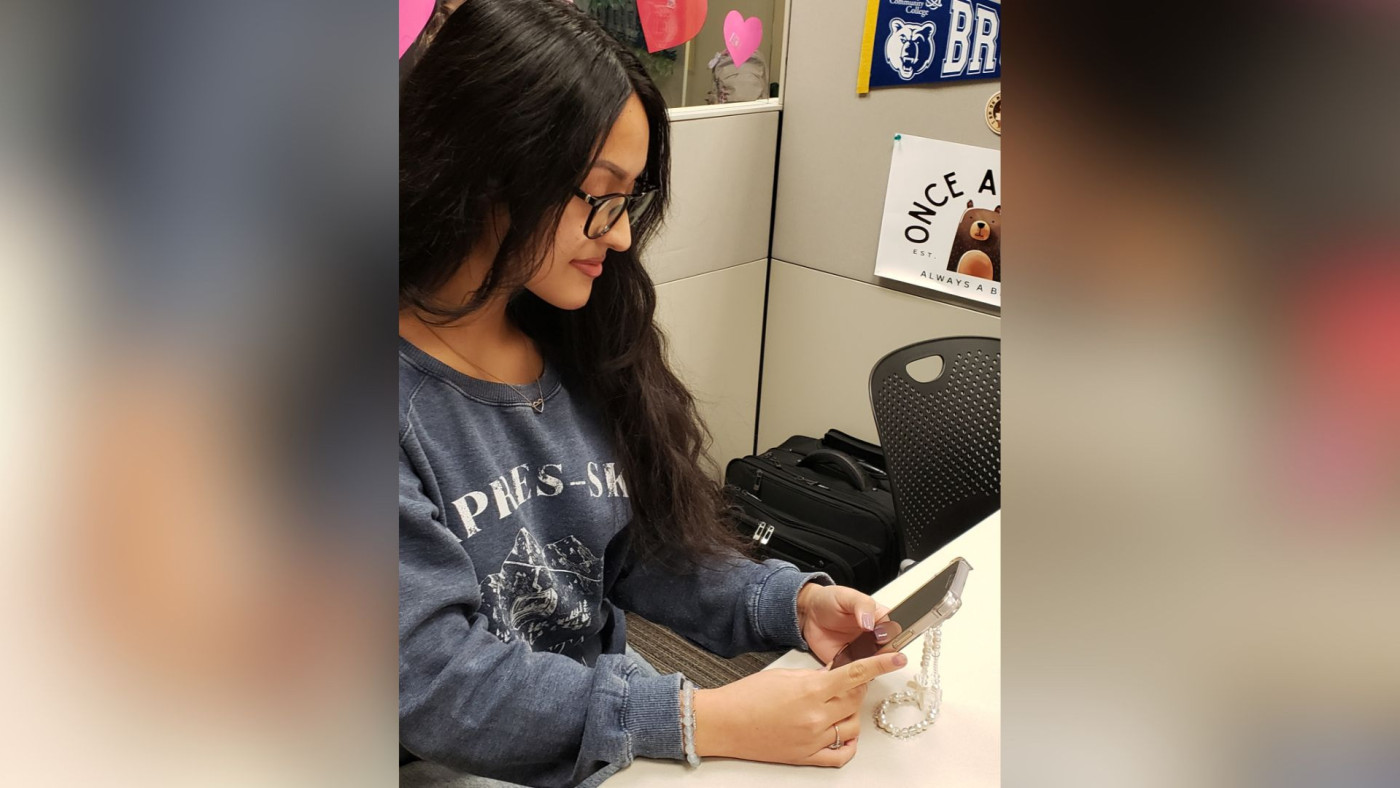
Josheanna Mortensen, a general studies major, sat in one of the upholstered chairs in the lobby of the student union between classes, using her phone to track her online time.  She totaled 15 hours for the week.

“I get the impression that people base their identity and entire existence on what’s happening online,” Mortensen said when she heard the phrase “chronically online.” 

In a SLCC BruinLens episode, Munashe Tanjani, a film production technician major, conceded sadness over her generation’s (Gen Z) reliance on smartphones. She acknowledged that it was more socially acceptable for her to start small talk with someone two decades ago and thinks her generation struggles with initiating conversations.

“For me, it becomes a crutch. I find it really sad that when I’m in an elevator with someone[and] it is easier for me to pull out my phone rather than strike up a conversation.” Tanjani said.  

The impact of excessive screen time

A  National Institute of Health (NIH) study showed that excessive screen time can lead to sleep deprivation, which has been linked to depression and other mood disorders.

Another consequence of being chronically online—according to DaSheek Akwenye, senior director of Center for Health and Counseling at SLCC—is that we stand to lose our ability to navigate social interactions effectively,  impacting our ability to be authentic and confident in various situations, like job interviews.

“We see with some of our college students as they apply for jobs, they don’t know how to interview. They don’t know the right words to use, make eye contact or have a firm handshake. Those social norms that we used to have, we’re standing to lose because we don’t have that in-person interaction,” he said.

The phrase ‘chronically online’ draws out different views     

According to Mortensen, excessive online activity can lead to forming opinions based solely on social media rather than using critical thinking and personal beliefs.

“I think when you are ‘chronically online’ you get ideas and opinions from social media versus using your own brain or ideology to come up with an answer,” Mortensen said.

Giselle McIntyre, a radiology major, considers five hours per day of online activity chronic. She calculated the ratio of hours online to hours in a day. 

“We have 24 hours in a day. We’re not up for 24 hours of the day, so if you’re using even half  that time on a screen instead of actually socializing, that’s ‘chronically online’,” McIntyre said.

“I just think that it has positives and negatives. So many new awarenesses really [do] help,” she said. “For example, my grandma was born in the 60s. I’ve downloaded Facebook on her phone and TikTok. I see her scrolling and she said, ‘I’ve never learned half of this information.’ She finds peace with that and she’s happy.” 

According to an NIH study on the impacts of internet use on older adults, social media improves older adults’ social well-being and interactions by expanding their ability to engage more fully and effectively.

On the flip side, McIntyre said she is grateful for her mother’s guidelines surrounding her online activity as a teenager.

“I was never on social media as a kid and I barely got [to use] social media my senior year of high school because of my mom. I felt left out at times, but I was more interactive, and I don’t think I got that depressive state. I got great grades and I wasn’t scrolling,” McIntyre said.

In a SLCC BruinLens discussion, Elizabeth Simmons, film production technician major and co-creator of the SLCC film production club, confessed that when she uses social media, she is willingly inviting algorithms that sway her.

“Using social media is such a weird thing to me because we know we are being manipulated by the algorithms, and we choose to participate anyway. So, it is active manipulation that we are opting into.”

Down the rabbit hole

According to a study in January 2022 “Harvard Business Review”, platforms are made to lead users into a social media rabbit hole that reduces the possibility of interruptions by providing bite-sized information that makes it simple to watch multiple videos or posts in succession.

Mortensen said she is a YouTube user and does not consider that addictive.

“I am a huge YouTube user but I don’t feel it’s as severe as if I was scrolling endlessly on TikTok or Instagram,” she said.

Alliance Umugwaneza, a first-year nursing student, admitted she routinely used the same app.

“I go back to TikTok excessively because I know where the app is,” she said.

Akwenye suggested that if being mindful of habits doesn’t work to reduce time spent on social media platforms, take proactive steps to limit screen time on these apps.

“The key is finding ways to be able to really limit our time on these apps whether it’s Instagram, TikTok or whatever social media platform that you might be engaging in,” he said.      

Akwenye recommended hiding those apps on one’s phone to avoid seeing Instagram and automatically opening the app. He also recommended setting time limits on apps.

Losing track of time while online

Umugwaneza admitted to often losing a sense of time while online. However, once it hits her, she seeks to correct her screen time.

“Yes, that happens. The battery is full and TikTok is my best friend. Even when I don’t realize it, I’m scrolling. I forget about time,” Umugwaneza said.

Whittling away hours online is something that Claudia Bahati, who is studying to be a sonographer, is aware of and she strives to curb her time.     . 

“Yes to be honest I just forget that I have other things to do so I found myself online all the time. Then I take a break from it,” she said. 

A 2021 Pew Research study, about three in ten American adults are online ”almost constantly,” which is up from 21% in 2015.

Mortensen said that sometimes she is aware of spending too much time online but gives herself a little longer to watch YouTube before her self-discipline kicks in.

“You know sometimes I’m guilty of both; where I will spend another hour on there and not even realize. Then I’m like, ‘OK I need to put the phone down and get back to my responsibilities.’”

McIntyre used screens to relax during winter break, but then she noticed time slipped through her fingers while online and took appropriate action.

“I would watch a movie and another one, and when the movie has an ad come on, then I’ll just watch TikTok or I’ll play a game,” said McIntyre.  “But then I realize I have been on this screen for over five hours and think, ‘What am I doing?’”

McIntyre admits that too much time leads to some physical conditions that cause her to take a break.     

“Honestly, my head starts to hurt and I kind of feel lazy, you know, and I just realized that this is not normal.”

McIntyre said boundaries are essential. “I think there definitely needs to be limitations.”

Teresa Chaikowsky reported and wrote this story as a journalism student at Salt Lake Community College.

OPINION | Gen Z’s dark humor masks deeper mental health struggles

This story is jointly published as part of the Utah College Media Collaborative, a cross-campus project bringing together emerging journalists from Salt Lake Community College, Southern Utah University, the University of Utah, Utah Tech University and Weber State University. The collaborative is an Amplify Utah project with support from PBS Utah.

Sitting on my cold dorm room floor the Sunday before spring semester began — still in my pajamas — I finally had to face procrastinating work, especially submitting a pitch for the Utah College Media Collaborative.

I needed to come up with an idea that explored Generation Z’s relationship with mental health and technology. Instead, I opened TikTok. As I scrolled, I kept seeing memes about Luigi Mangione, the 26-year-old man arrested for the murder of UnitedHealthcare CEO Brian Thompson just weeks before. 

Then it hit me. 

As the editor-in-chief of Sun News Daily, I decided to pitch a story about Gen Z’s dark humor online. 

Being part of Gen Z forced me to confront my own view on this brand of humor and my relationship with technology. As I reflected on my social media use, I realized I had grown to depend on it to distract myself from feelings of anxiety. 

My first introduction to technology was the computer lab at my small-town elementary school. I can’t remember a time during my school years without having access to a phone or computer. Even as early as first grade, I was constantly interacting with media through the internet.

Then, in junior high, I caught the social media bug. The first social media platform I had was Pinterest, if you even consider that social media. Next was Snapchat, then Instagram, and eventually, TikTok. 

I grew up with social media, something previous generations haven’t experienced. Millennials had Myspace and Facebook, but that was when social media was new and upcoming — it still had its luster. It hadn’t hit the point of toxicity that it holds now, and it wasn’t something that had a chokehold on young adults.

Sure, social media has positives, but it’s a double-edged sword. You have to take the good with the bad – and studies show there’s a whole lot of bad. While I love all of the funny TikToks I have saved, social media has done more harm than good for me. 

Our story for the Utah College Media Collaborative unfolds Gen Z humor and delves into the mental health challenges this generation is currently facing. 

For some, dark humor online is a way to cope with mental health challenges. It can be an escape from reality that offers a level of relief. Yet, I cannot ignore all the downsides of social media. I don’t blame social media for my mental health challenges, but it certainly hasn’t helped. 

I’m in a constant state of comparing myself to others and feeling I’m never good enough. I can’t be the best editor-in-chief because I’m always looking at other news organizations’ incredible work. Or, I can’t possibly be attractive enough for someone to date because there are all these beautiful women out there, far more pretty than I am.

The feelings of anxiety I have are always made worse by scrolling through social media. I’m spammed with political issues or news of illnesses and natural disasters I have no control over. It’s not healthy for me to see a spam of these things because, even if they are true, I start to obsess over them, throwing me into an anxiety-driven spiral.

While it’s nice we have our funny little videos on social media, there’s a bigger picture here and a bigger problem — a large portion of Gen Z is suffering from mental health challenges, and technology has only made it worse.

Yes, Gen Z’s online humor is fun, and I also get a good laugh from scrolling on TikTok, but I have to start distancing myself from social media. 

While the collaboration started as a project for Sun News to participate in, it quickly turned into a moment of self-reflection. I realized I rely too much on social media to help “cure” my worries when that’s not how worries are cured. Social media has been a quick-fix distraction that leaves me with more feelings of anxiety than I had without it.

My lesson is this — I can’t rely on social media to ease my mind. I cannot rely on something that is materialistic. All these funny videos we have are just — videos. They aren’t life-changing, and they won’t provide a long-lasting coping mechanism.

So, I urge my fellow Gen Zers to take a step back and examine how you use social media in your own lives. Is it really helping with your worries, or just distracting you for a little while?

Lexy Borgogno reported and produced this story as a digital media student at Utah Tech University.

Tragedy, TikToks, taboo jokes: Understanding Gen Z’s humor

By Alyssa Bayles and Ives Hong

This story is jointly published as part of the Utah College Media Collaborative, a cross-campus project bringing together emerging journalists from Salt Lake Community College, Southern Utah University, the University of Utah, Utah Tech University and Weber State University. The collaborative is an Amplify Utah project with support from PBS Utah.

When Luigi Mangione was arrested for shooting UnitedHealthcare CEO Brian Thompson on a New York City sidewalk in December, Gen Z quickly turned the tragedy into memes across Instagram, X and TikTok. The online reaction — ranging from grief to celebration — sparked debates about the appropriateness of such dark humor.

“[Dark humor] can use language or things that have happened that you shouldn’t be joking about, but that’s what the jokes are sometimes,” said Garrett Balok, a general studies major from Utah Tech University.

For Gen Z, individuals born between 1997 and 2012, this type of dark humor serves a purpose beyond mere entertainment, often functioning as a coping mechanism for mental health challenges. According to Harmony Healthcare IT, 42% of Gen Z have been diagnosed with a mental health condition.

“For young people who’ve grown up from the recession in 2008 and 2009 to all the chaos that’s happened since then, it’s been a long time,” said Dannelle Larsen-Rife, professor of psychology at Utah Tech University. “They feel this helpless and hopeless [as they try] to grapple with these really big, big issues.” 

There has been an emerging pattern of reflecting tragedy through humor amongst Gen Z. Mental health experts and sociologists say this is caused by an increasingly chaotic world, where younger people use a combination of dark humor and digital culture to face these unique challenges. 

“Mental health problems are very high among Gen Zers right now, and perhaps, that is also being played out in the types of humor that they’re making,” said Bethany Gull, instructor of applied sociology at Utah Tech. 

Incidents like the Luigi Mangione case or the Titan submarine implosion quickly became subjects of memes and jokes across digital platforms.

Social media platforms have played a significant role in how Gen Z processes serious social issues. Incidents like the Luigi Mangione case or the Titan submarine implosion quickly became subjects of memes and jokes across social media platforms.

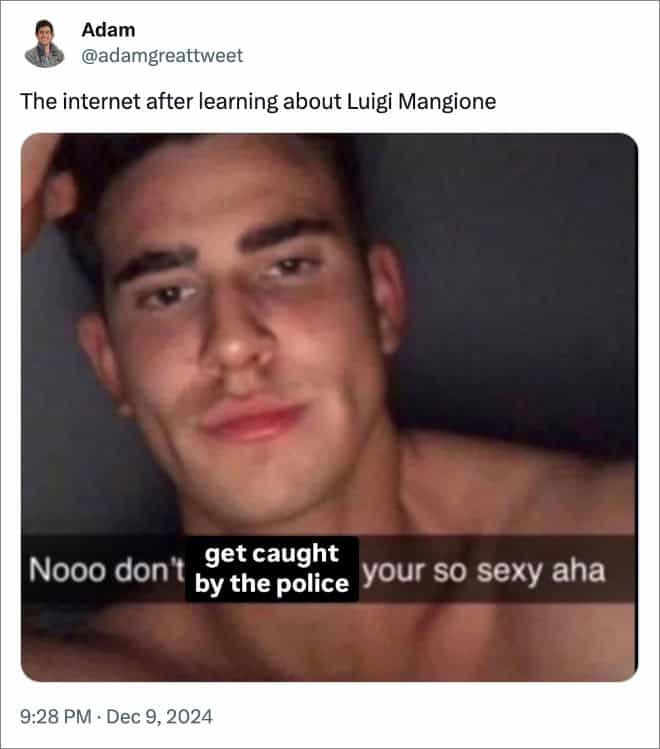
Meme shared through X about Luigi Mangione’s appearance.

As intense events take over the news cycle, from the 2024 election and the LA fires, Gen Z turns to humor using memes to both acknowledge and cope with them, according to a study by Abilene Christian University. 

While the American Psychological Association reports Gen Z is more likely to report experiencing mental health conditions than previous generations, Gen Z is one of the first generations who have improved in expressing their emotions

Joshua Henrie, a population health major at Utah Tech, said he’s leaned on dark humor as a coping mechanism. 

“It’s something people use to get through hard things and mentally straining things,” Henrie said. “It might not always be appropriate or anything like that, but it’s how people get through things.”

This phenomenon isn’t exclusive to Gen Z. Weslie Janda, a general studies major at Utah Tech, noted experiencing similar humor with her parents, though she acknowledged it is “more common and severe” among her generation.

The increased usage of social media platforms like TikTok, Instagram, Snapchat and YouTube over the last decade has allowed Gen Z to connect through shared humor in unprecedented ways. However, this connectivity also comes with unique challenges. 

“We used to graduate from high school, get a job, get married, have a child and buy a home,” Gull said. “It doesn’t look the same way that it did 30, 40 years ago. I think some of this humor is just a reflection of how there are very few absolutes anymore.”

Even historical tragedies like 9/11 have become subjects of memes for Gen Z, which raises questions about when humor crosses boundaries of appropriateness, as discussed in an issue of “The Criterion.

Oh shit hell no | image tagged in reposts are allowed,memes,funny,dark,9/11,planes | made w/ Imgflip meme maker
Meme about 9/11.

Some members of Gen Z view this humor negatively. Jimmy Thurston, an electrical engineer major at Utah Tech, said he finds it annoying and irritating.

“People do it because they want to test boundaries. They want to test limits. They want to see how badly/how much can [they] push this, [and] how much further can [they] go with this,” Thurston said.

John Jones, professor of psychology at Utah Tech, said it allows people the “opportunity to be irreverent.” 

Janda pointed to internet anonymity as a factor enabling boundary-pushing humor without consequences.

“You can kind of just say whatever you want and it doesn’t have impacts on your real life, day-to-day situations,” Janda said. “So, you can make those kinds of jokes with no real repercussions.”

Jones added that online environments can encourage less empathetic behavior.

“It’s essentially easier to be cruel online,” Jones said. “And that could be one manifestation of online cruelty.”

Alyssa Bayles and Ives Hong reported and produced this story as English and psychology students at Utah Tech University.